
A Farmer’s Guide to Choosing the Right Skid Steer Bucket
Introduction
Selecting the right skid steer bucket can transform your farming routine, improving both productivity and equipment longevity. This guide breaks down critical factors in skid steer bucket selection, ensuring you match attachments to your operational needs. Explore the essentials for making a smart, lasting investment and streamline your workflow for the seasons ahead.
Understanding the Landscape of Skid Steer Bucket Types
Many farmers assume any bucket will handle most jobs, but each design is optimized for specific applications. Knowing the differences ensures equipment efficiency and durability.
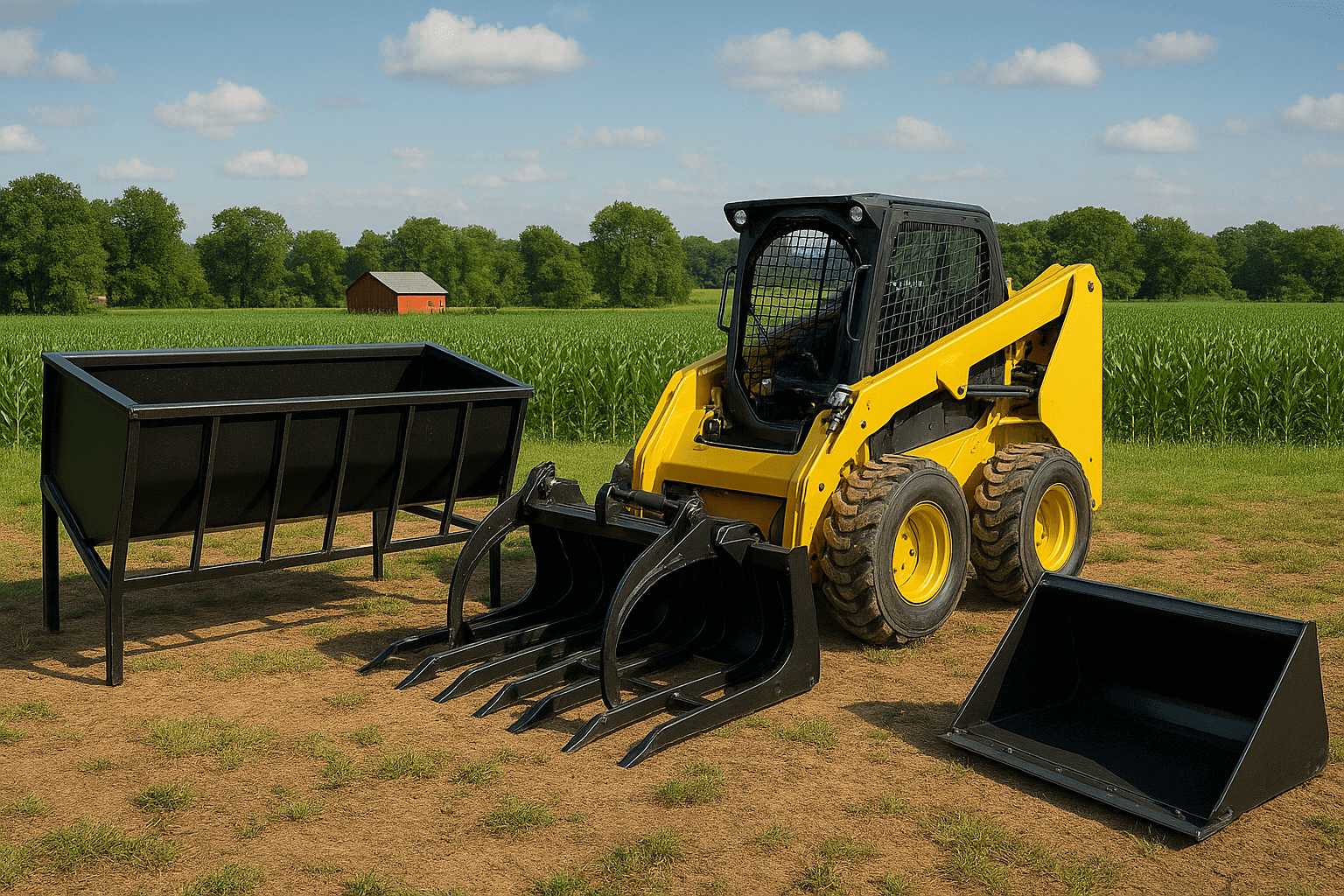
General-Purpose Buckets – Reliable for feed, soil, and gravel, with moderate heel angles for good loading and dumping, though wet manure may stick.
Rock Buckets – Built with heavy bar tines to let fines fall through while retaining stones, ideal for field reclamation but less effective for silage due to leakage.
Manure or Litter Buckets – Feature taller backs and perforated sides to shed liquid while retaining bedding; ideal for fast stall clean-outs, but can overload with dense gravel.
4-in-1 or Multipurpose Buckets – Feature hinged jaws acting as a clamshell, dozer blade, and grader. Their versatility is notable, though added hydraulics increase cost and weight.
High-Capacity Buckets – Wider and deeper for light materials like corn silage. Overfilling with wet sand can stress loader arms and reduce pin life.
It is a misconception that swapping buckets for different chores saves money. Using a rock bucket for grain, for example, can reduce efficiency by up to 30 percent due to spillage and increased edge wear. Matching the right skid steer bucket types to specific jobs keeps cycle times low and protects your equipment.
Sizing Up Success with the Right Capacity and Dimensions
After choosing a style, focus on the right bucket capacity. The width should not exceed your skid steer’s outside tire width by more than two inches to avoid bumping into gates or feed bunks. Bucket depth determines loading volume, but deeper buckets raise your machine’s center of gravity, which can lift rear wheels on compact models.
- List all materials you handle weekly, such as feed, manure, gravel, and silage.
- Note the average density of each material. Wet manure can reach 75 lbs/ft³, while chopped hay averages about 18 lbs/ft³.
- Multiply density by your desired cubic-foot load to ensure it remains under 50 percent of your loader’s tipping load.
- Measure doorways, alley widths, and trailer beds you regularly load.
- Check your hydraulic flow, as high-capacity multipurpose buckets often require an extra 5 GPM for smooth operation.
- Overloading shortens machine life and voids warranties, while spillage can waste feed and increase cleanup time. Undersized buckets extend working hours. Mulltek engineers each bucket to optimize volume and weight, so you handle more material without overstressing pins or cylinders. For a quick check, fill your current bucket as usual, weigh it, and if it exceeds 80 percent of rated capacity, consider stepping down a size.
Handy Measurement Tips
- A drywall square provides instant depth and height measurements.
- Spray-paint marks at quarter, half, and three-quarter fill levels help seasonal workers avoid overloading.
Durability in the Field with Materials and Build Quality
The longevity of your bucket depends on the steel and welds holding it together. Mulltek uses high-grade 50,000-psi steel, double-passes critical seams, and stress-relieves frames before powder coating for corrosion resistance. Here is how premium buckets compare with economy imports:
- Feature – Economy Imports – Mulltek Field-Tested Buckets – Why It Matters on Your Farm
- Base Material – Mild carbon steel, 3/16″ – 5/16″ high-strength steel – Higher abrasion resistance reduces edge replacement costs
- Cutting Edge – Single bevel – Reversible, bolt-on – Flip the edge to double its life; swap in minutes
- Weld Integrity – One root pass – Root and cap pass, robotic HT fillet – Prevents cracks under shock loads from frozen manure
- Wear Plates – None or spot weld – Full-length AR400 plates – Deflects impact from rocks and ditch cleaning
- Common problems like early rust or toe-plate curling are minimized when buckets are built to withstand varying climates. To extend service life, rinse corrosive silage acids weekly, touch up scratches with matching enamel, and grease tilt pins every 50 hours.
Built for Real-World Demands
Mulltek’s design team combines farming and fabrication expertise, incorporating practical features such as gusseted steps for safe cab entry, serrated edges for breaking ice, and integrated chain slots for fast trailer tie-downs. Every prototype is tested on our family farm before being offered for sale, ensuring field-proven reliability.
Versatility and Specialized Attachments for Everyday Efficiency
Skid steers become more versatile with the right attachments. Consider these add-ons to maximize your investment:
- Grapple Top – Bolt-on arms secure round bales or debris without changing tools.
- Bolt-On Cutting Edge – Replace worn edges easily; opt for serrated for hard-pack or smooth for feedlots.
- Bale Spear Inserts – Insert twin spears for hay season, remove for snow work.
- Custom Solutions – Mulltek’s CNC plasma table allows for one-off designs, such as narrow buckets for poultry houses.
- Unlike generic attachments that may have misaligned pins or unreliable hardware, Mulltek customizes each attachment for your skid steer, ensuring perfect coupler geometry and safe hydraulic routing. When reviewing attachments, check for proper cylinder hose routing, ensure grapple tines close flush to the bucket floor, and confirm that overall weight remains within 10 percent of rated capacity.
Safety Considerations
- Relieve hydraulic pressure before disconnecting quick couplers.
- Add bolt-on steps if attachment width restricts cab access.
- Label auxiliary lines to prevent operating errors.
Making the Investment Count with the Mulltek Advantage
Before purchasing, consider total ownership costs:
- Supplier Reputation – Choose companies led by farmers, not just importers.
- Warranty Scope – Three-year weld warranties, like Mulltek offers, provide peace of mind.
- Support Access – Direct phone support from the fabricator is invaluable during busy seasons.
- Parts Availability – Essential parts like bolt-on edges and pins should ship within 48 hours during critical times.
- Resale Value – Buckets with reversible edges and serial plates retain higher auction value.
- Mulltek’s competitive edge is rooted in advanced in-house fabrication, top-grade steel, and a family-driven culture. Every batch is tested on our ranch, with welds ultrasonically scanned before powder coating. This commitment ensures seams remain tight and paint endures season after season.
Quick Buyer’s Checklist
- Does the bucket cover at least 90 percent of your weekly tasks?
- Can it handle your heaviest material without exceeding 80 percent of the tipping load?
- Are wear points easily replaceable with common tools?
- Is after-sales support readily available?
- Mulltek offers a complete line of solutions, from standard to custom options, tailored to your horsepower, acreage, and climate needs.
Current Trends and Market Insights
The skid steer bucket market is evolving rapidly. Technological advancements such as telematics and automation are being integrated into attachments, allowing operators to monitor equipment performance remotely and improve efficiency while reducing downtime. There is increased demand for compact, multi-functional machines, driven by urban construction projects and the need for higher maneuverability and diverse task execution.
Market forecasts show robust growth. The global loader bucket market is projected to grow at a CAGR of 4.6 percent from 2025 to 2035, reaching USD 6.11 billion by 2035, driven by infrastructure projects and mechanized farming. The skid steer loader market is expected to expand from USD 4.35 billion in 2025 to approximately USD 12.92 billion by 2035, fueled by an 11.5 percent CAGR and demand from construction, agriculture, and landscaping sectors.
General-purpose buckets are projected to account for 32.5 percent of the loader bucket market value share in 2024, highlighting their versatility. The sand and gravel segment is expected to hold the largest application share at 36 percent in 2024, driven by construction and infrastructure projects.
These trends indicate the importance of choosing the right bucket and attachments for your operation. Farmers who prioritize equipment suited to their needs will benefit from increased efficiency, reduced downtime, and maximized investment value.
Bringing It All Together for a Productive Season
Choosing the right skid steer bucket types, sizing them accurately, demanding high build quality, and equipping them with the best attachments can turn your loader into the backbone of your operation. Mulltek’s farmer-driven designs, rigorous testing, and personal service take the guesswork out of skid steer bucket selection. For those aiming to save time and extend machine life, our team is ready to help you find the perfect fit. Every season brings new challenges—let’s tackle them together with gear built by farmers, for farmers.
Conclusion
Your operation’s efficiency and reliability start with the right skid steer bucket selection. By aligning type, capacity, durability, and attachments to your needs, you secure lasting performance and value. Let Mulltek’s expertise guide your investment for maximum results. Discover more about Our Products.
References
Technological Advancements Integration of smart technologies
Increased Demand for Compact and Multi-Functional Machines
Loader Bucket Market Growth
Skid Steer Loader Market Expansion